- Published on
Darjeeling — Mist, Memory, and the Mountains
- Authors
- Name
- Rehber Moin
- @r3hbr


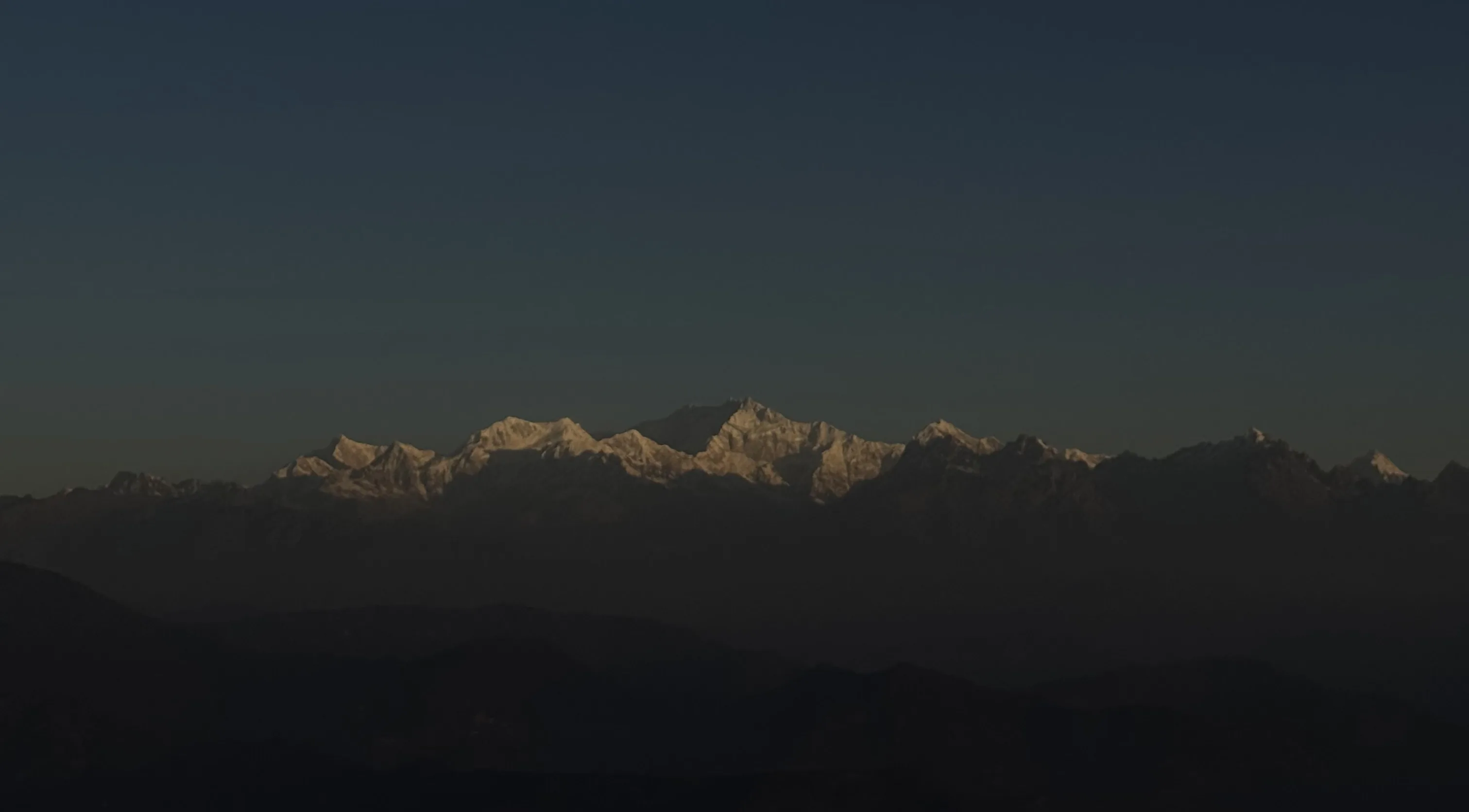
Kanchenjunga — distant, quiet, and impossible to ignore.
I’m back — but this time, not with a blog about the latest doo-dad at the forefront of tech, or some gizmo shaking the very core of the industry.
After a lot of deliberation, I finally did something I’m notoriously bad at: I took a break.
I was heading back home anyway, and December felt like the perfect excuse to squeeze in a short vacation somewhere nearby. December, however, also meant the cold — bitterly cold. Around 14°C, a temperature that usually sends me straight into hibernation.
Still, I decided to challenge myself. If not my fear, then at least my complete inability to tolerate cold.
At some point, my decision-making process began to resemble a badly designed mathematical model:
Where:
- ( k ) is an arbitrary constant
- logic is optional
- enthusiasm is mandatory
After a very serious (and extremely scientific) scan through Horman’s Atlas and an old encyclopedia lying around at home, the solution converged rather naturally.
Darjeeling.

Darjeeling as seen through colonial cartography — when the hills were mapped, named, and romanticized.
There was another reason, a far more personal one.
I am a huge Satyajit Ray fan. His iconic detective, Feluda, has a well-known fondness for hill stations, and many of his adventures unfold in places wrapped in mist, mystery, and altitude. One such story is Darjeeling Jomjomat — quite literally translating to The Darjeeling Mystery.
That was all the convincing I needed.
Destination status: finalized.
Flights booked, hotel reserved, bags hurriedly packed — and just like that, we were off to the races.
✈️ Day 0 — Arrival Day
Calcutta → Bagdogra
We took a later flight from CCU to IXB, flying with IndiGo.
(For context, this decision was made before the great IndiGo flight-cancellation fiasco — more on that here.)
Once at the airport, we did what we usually do: retreated to the lounge. The food was mediocre, the coffee somehow worse, but it served its purpose.
Our flight was scheduled to depart at 18:10 IST, with boarding set to begin at 17:25 IST. Everything looked on track when we checked the flight status, so around 17:00 IST, we headed toward the boarding gate.
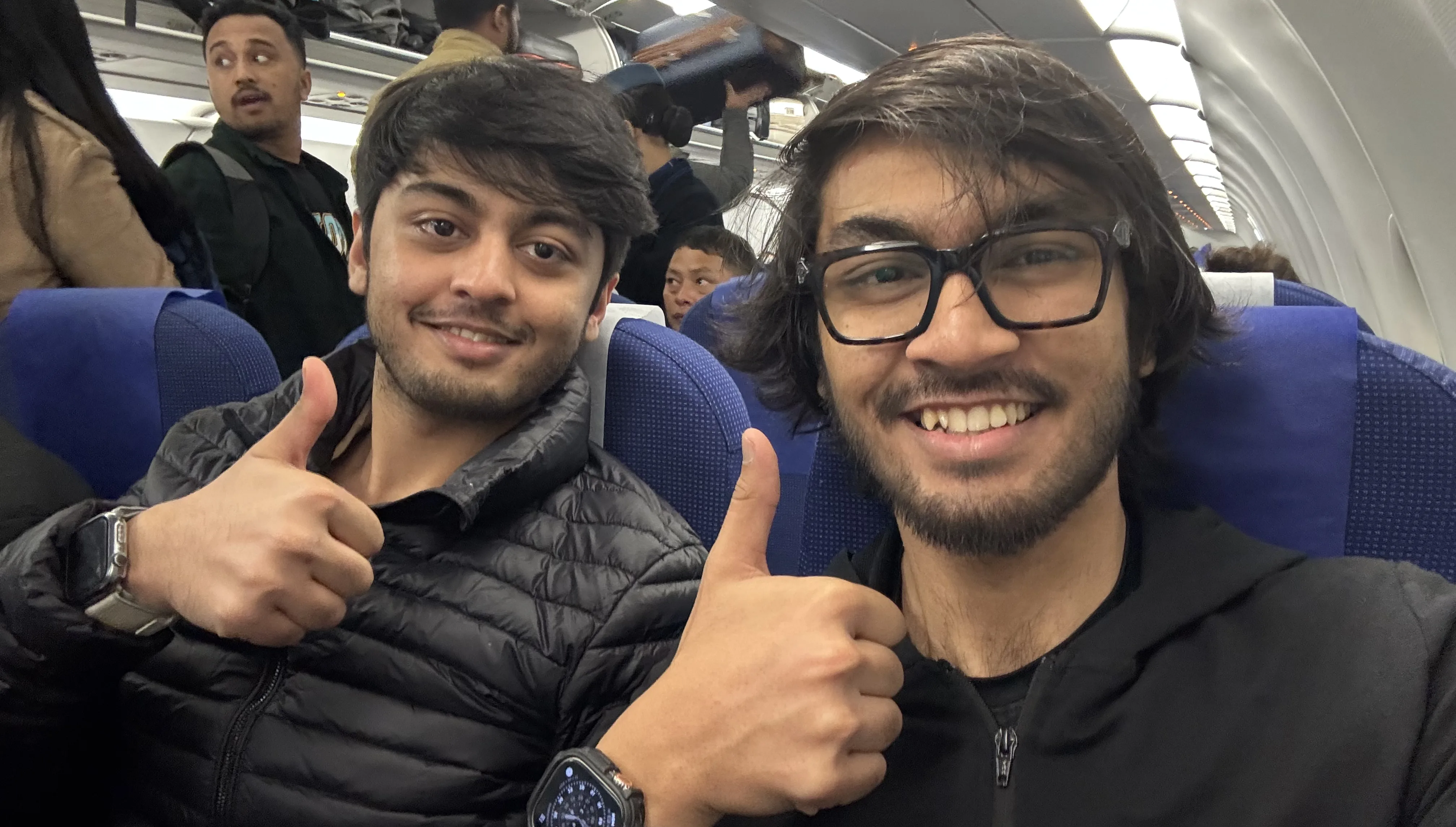
Finally boarded — relieved after the delay.
Little did we know, the flight was about to be delayed by an hour.
Honestly, we preferred that over the alternative — outright cancellation.
After a mildly nail-biting wait, boarding finally began, and not long after, we touched down in Bagdogra.
We had a cab pre-booked to take us to our temporary overnight stay, but the delay meant we missed it entirely. Tired and running low on patience, we took a small gamble and reached out to the local drivers.
It turned out to be the right call.
Not only did they help us get to our hotel safely, but they also assisted us in arranging transport from Siliguri to Darjeeling for the next leg of the journey — a story worth its own mention later.
🏔️ Day 1 — Ascent to the Hills
Siliguri → Darjeeling
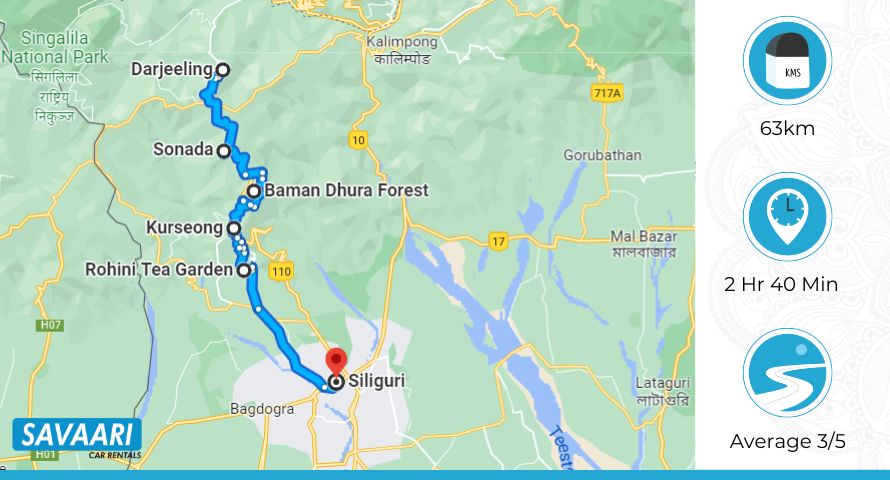
The winding ascent from Siliguri into the Darjeeling hills.
We woke up early, grabbed a quick but satisfying breakfast, and waited for our cab — the real journey was about to begin.
As we left Siliguri behind and began the gradual ascent toward Darjeeling, the landscape shifted almost immediately. Flat plains gave way to winding mountain roads, dense greenery, and layers of hills stacked one behind another. These were views I had previously only encountered in photographs and travel essays — now unfolding in real time.
🌱 Tea Estates of the Foothills
Historical Note
Darjeeling’s tea legacy dates back to the mid-19th century, when the British identified the region’s climate and altitude as ideal for tea cultivation. What began as an experiment soon evolved into one of the world’s most celebrated tea-producing regions.
The tea estates at the foothills are where this story begins. Long, orderly rows of tea bushes stretch across the slopes, quietly shaping both the economy and the identity of the region.
Leaving Siliguri — tea gardens and foothills easing us into the mountains.
🚂 The Toy Train
Historical Note
The Darjeeling Himalayan Railway, completed in 1881, is a narrow-gauge railway engineered to navigate steep gradients and tight curves. It later earned UNESCO World Heritage status for its innovative design.
Seeing the toy train running alongside the road felt surreal — a moving relic of colonial engineering, still chugging its way through the hills more than a century later.
The Darjeeling Himalayan Railway cutting through the lower hills.
🚉 Sukna Station — Gateway to the Hills
Historical Note
Sukna Station historically marked the transition point between the plains and the hills, serving as a key logistical stop for goods and passengers heading toward Darjeeling.
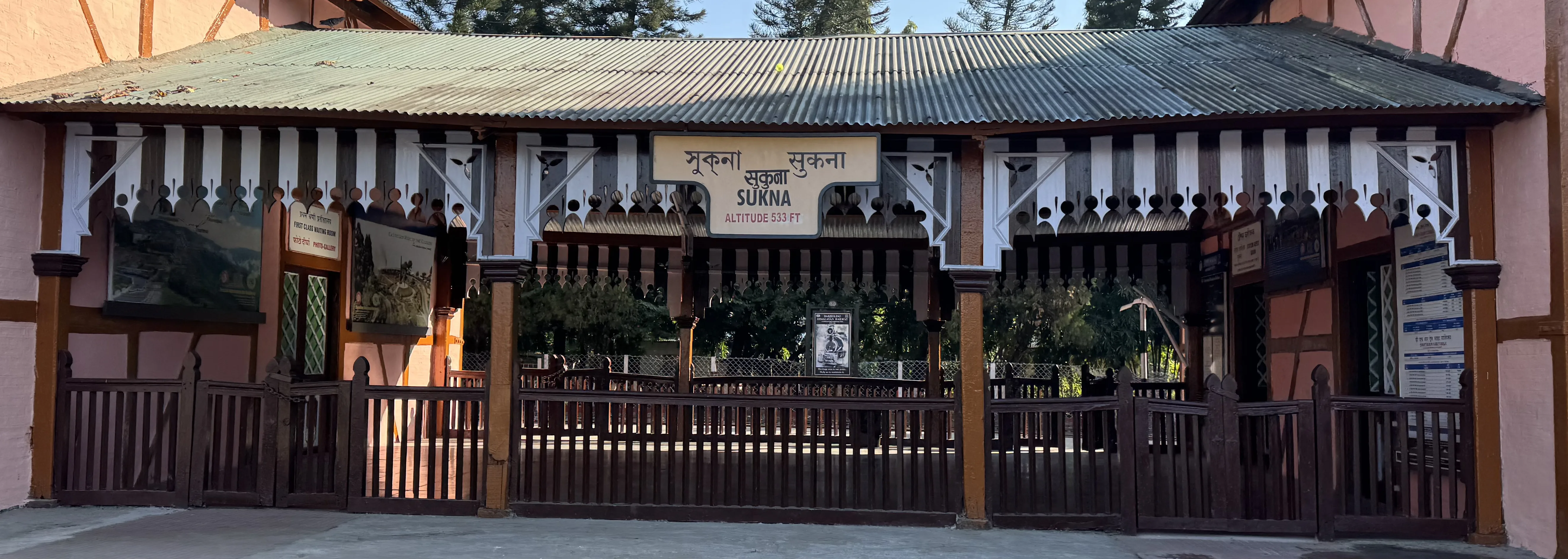
Sukna Station — where the plains end and the climb truly begins.
☕ Margaret’s Deck — A Pause Worth Taking
Margaret’s Deck felt less like a café and more like a deliberate pause built into the journey.
Context
Named after Margaret Hope, the surrounding tea estate carries forward Darjeeling’s deep-rooted tea heritage.
Perched amidst tea gardens, the deck opens up to sweeping views of rolling hills and endless greenery — the kind that quietly insists you slow down.
A slow pan across Margaret’s Deck — tea, hills, and unhurried moments.
There, we polished off some cake and sandwiches — simple food, elevated by fresh mountain air and an unforgettable view.
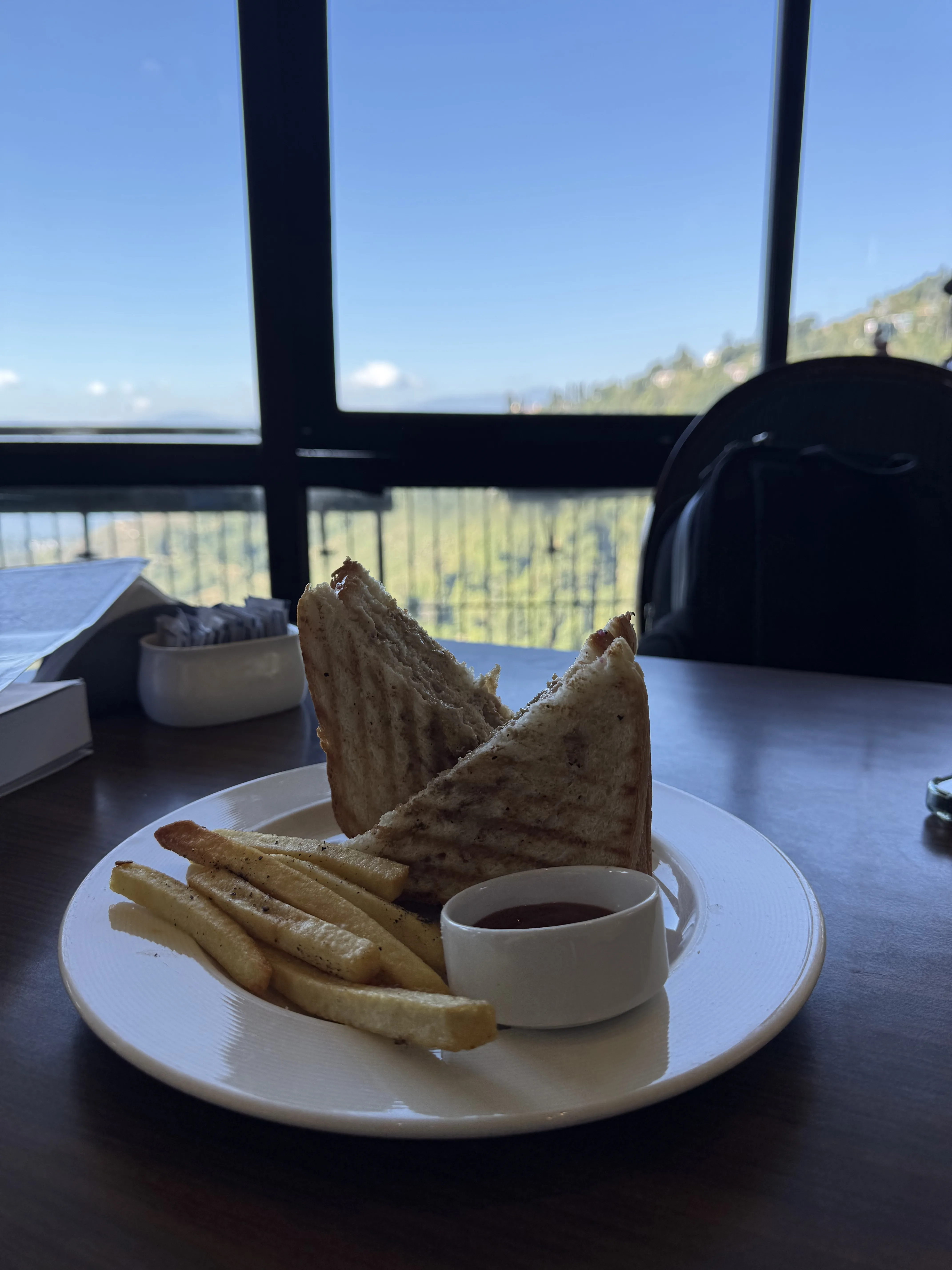
Cake, sandwiches, and a view doing most of the work.
After our short pit stop, we set out on the final leg of the journey toward the “Queen of the Hills” — Darjeeling.
Cultural Note
Darjeeling has long been a favored backdrop for Indian cinema, its misty streets and colonial architecture lending themselves naturally to romantic and nostalgic storytelling.
Many of my favourite films have been shot here, and the one that immediately came to mind was Barfi! — a film I cannot recommend enough. As we drove on, I began to recognize a few landmarks (we’ll come back to those later), while the air outside grew colder, carrying a gentle, almost sweet nip.
I had arrived.
Then, at a distance, I saw something that felt almost spiritual.
🏔️ First Sight of Kanchenjunga
Geographical Note
Kanchenjunga, standing at 8,586 meters, is the third-highest mountain in the world. Revered by locals and mountaineers alike, it is often considered sacred and is deeply woven into the cultural identity of the region.
For the first time in my life, I saw Kanchenjunga.
Not a photograph.
Not a video.
Not an AR or VR set piece.
The real thing.
The mountain stood there in quiet dominance — immense, unbothered, and impossibly beautiful. I felt a sudden tremor in my chest, followed by an involuntary, prideful smile. It was one of those rare moments where words struggle to keep up with emotion.
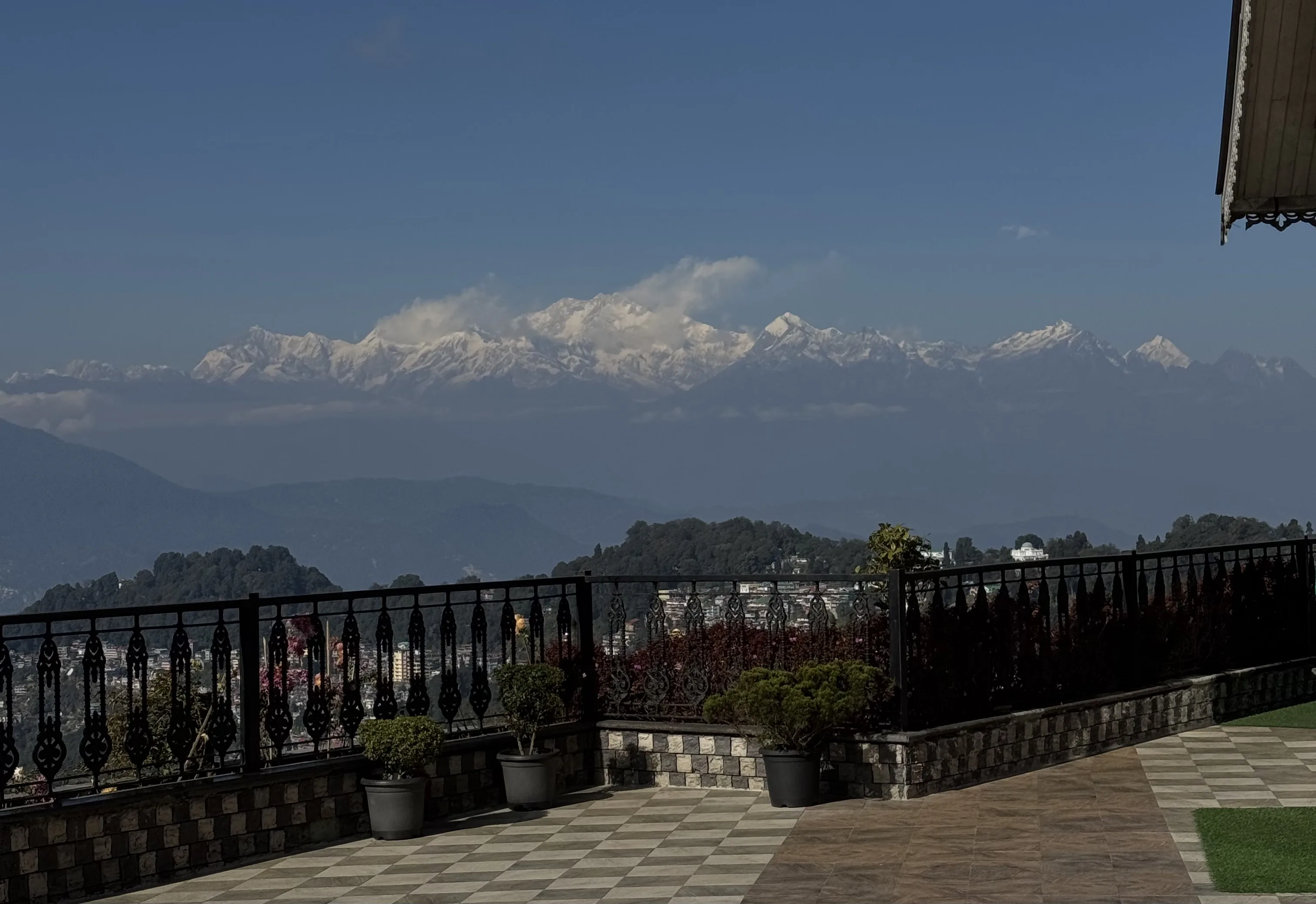
First sight of Kanchenjunga — overwhelming, humbling, unforgettable.
🏙️ The Mall (Chowrasta)
Historical Note
Commonly known as Chowrasta, the Mall has historically served as Darjeeling’s social and cultural nucleus — a place for evening walks, public gatherings, and unhurried conversations.
After checking in and taking a quick shower, I headed straight for the Mall. This is where Darjeeling seems to slow itself down deliberately. Locals, tourists, and vendors drift through the space, framed by views that casually remind you how small you are.
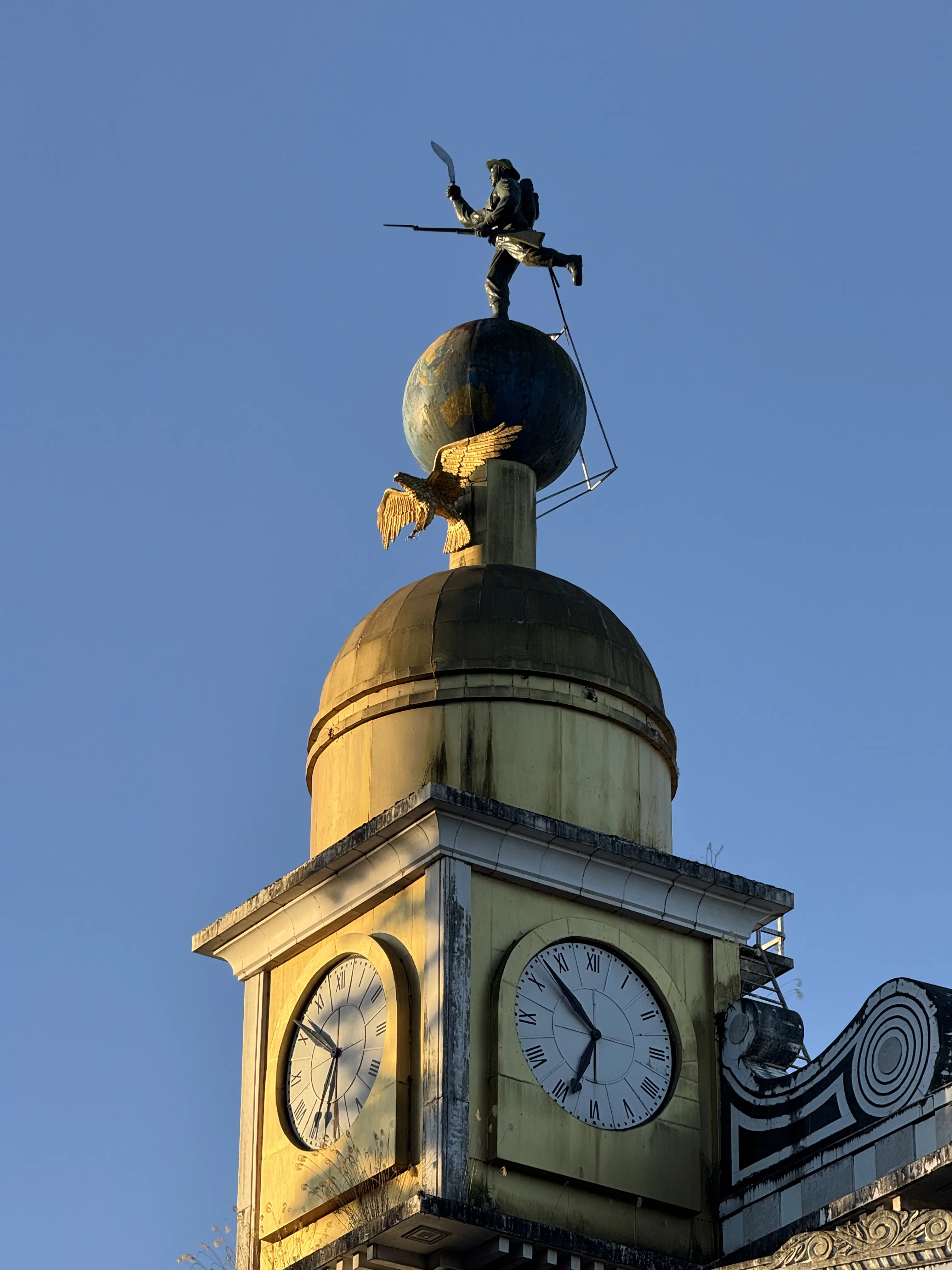
Chowrasta — Darjeeling’s social heart, unhurried and timeless.
🍰 Glenary’s — An Institution
Historical Note
Established in the early 20th century, Glenary’s began as a bakery and tearoom during the British era and has since grown into one of Darjeeling’s most iconic establishments.
From the Mall, we made our way to Glenary’s — part bakery, part café, part restaurant, and very much a Darjeeling institution.
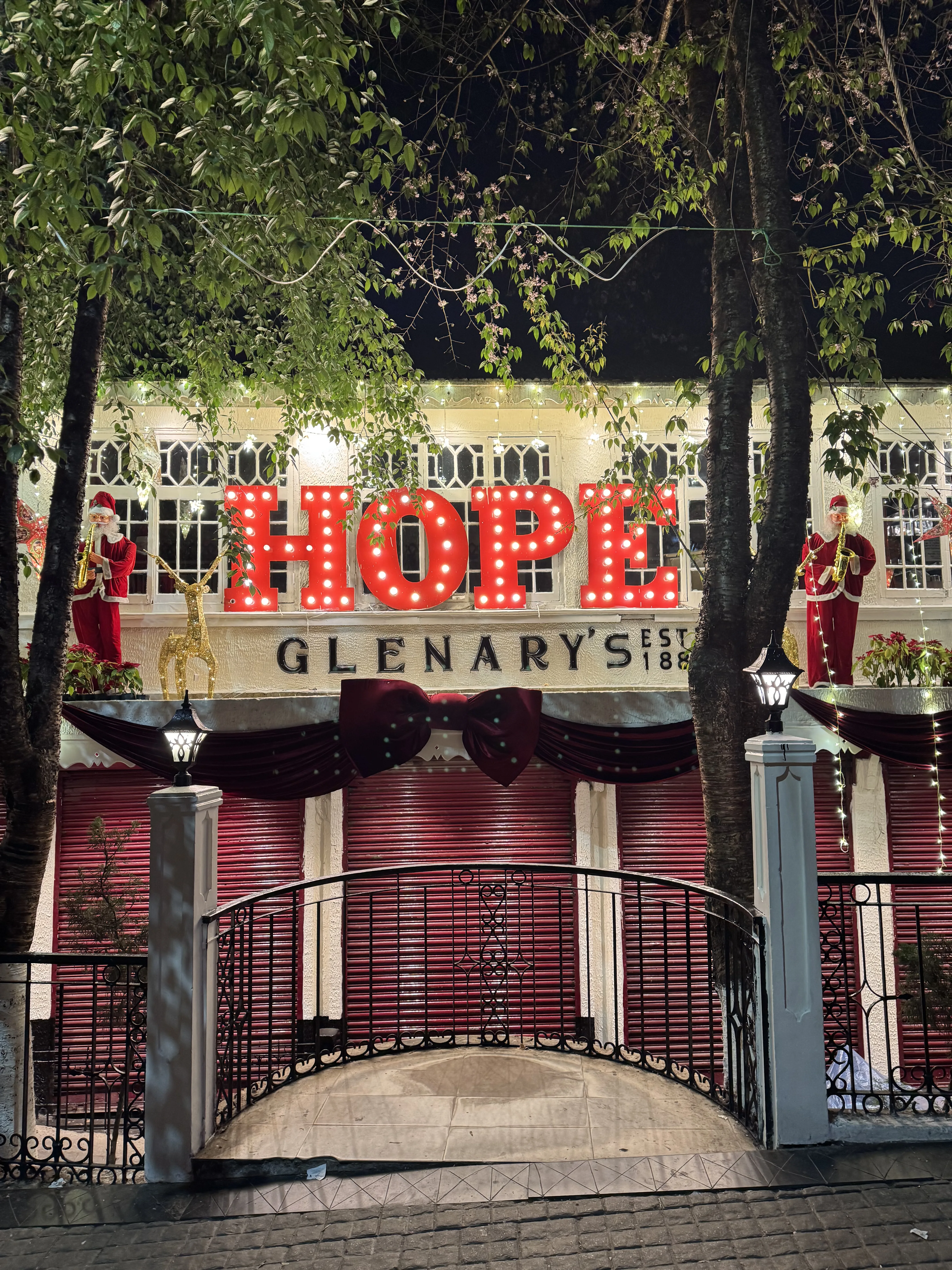
Glenary’s — an institution that has stood the test of time.
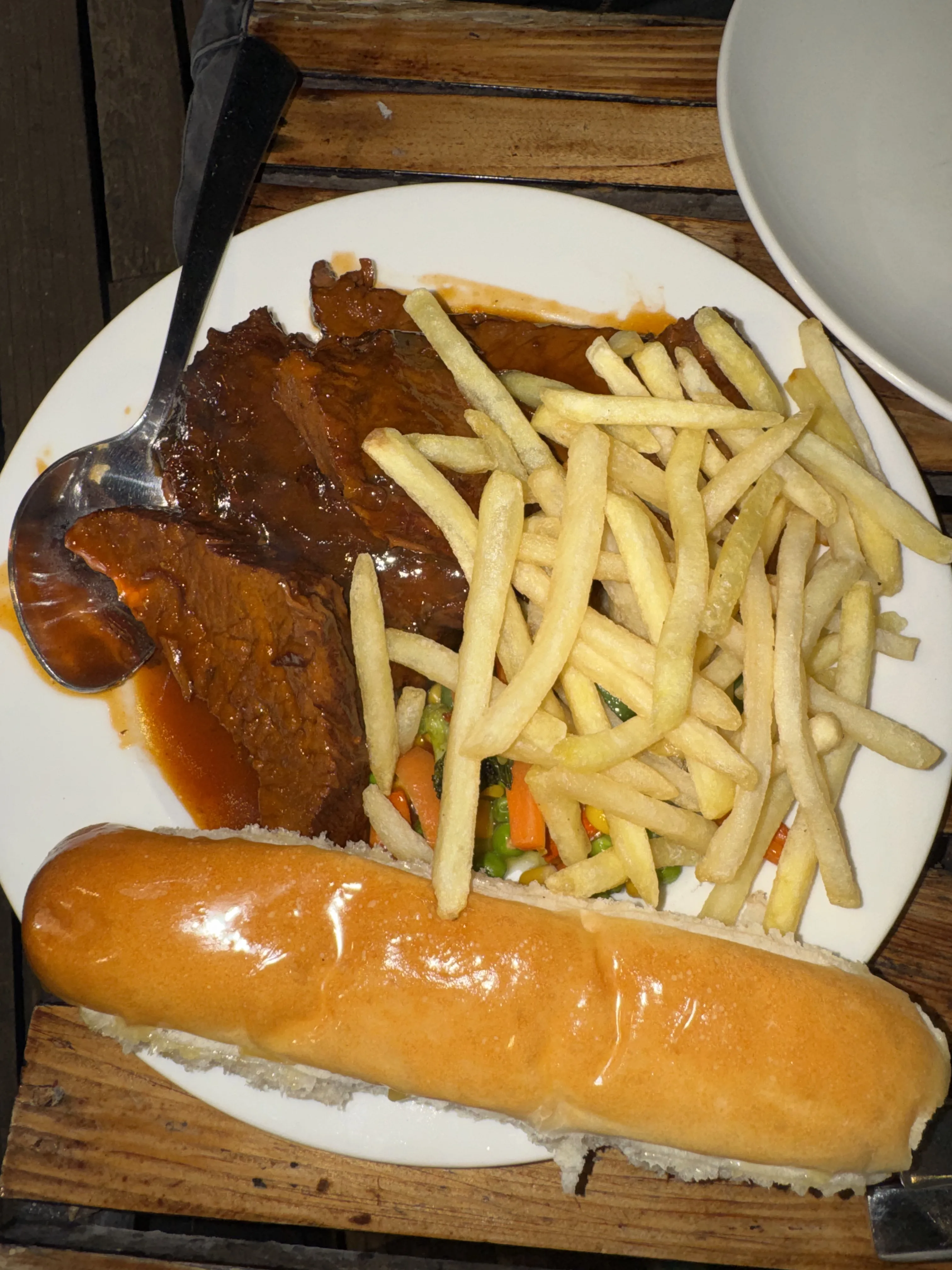
Comfort food and indulgent desserts — Glenary’s classics.
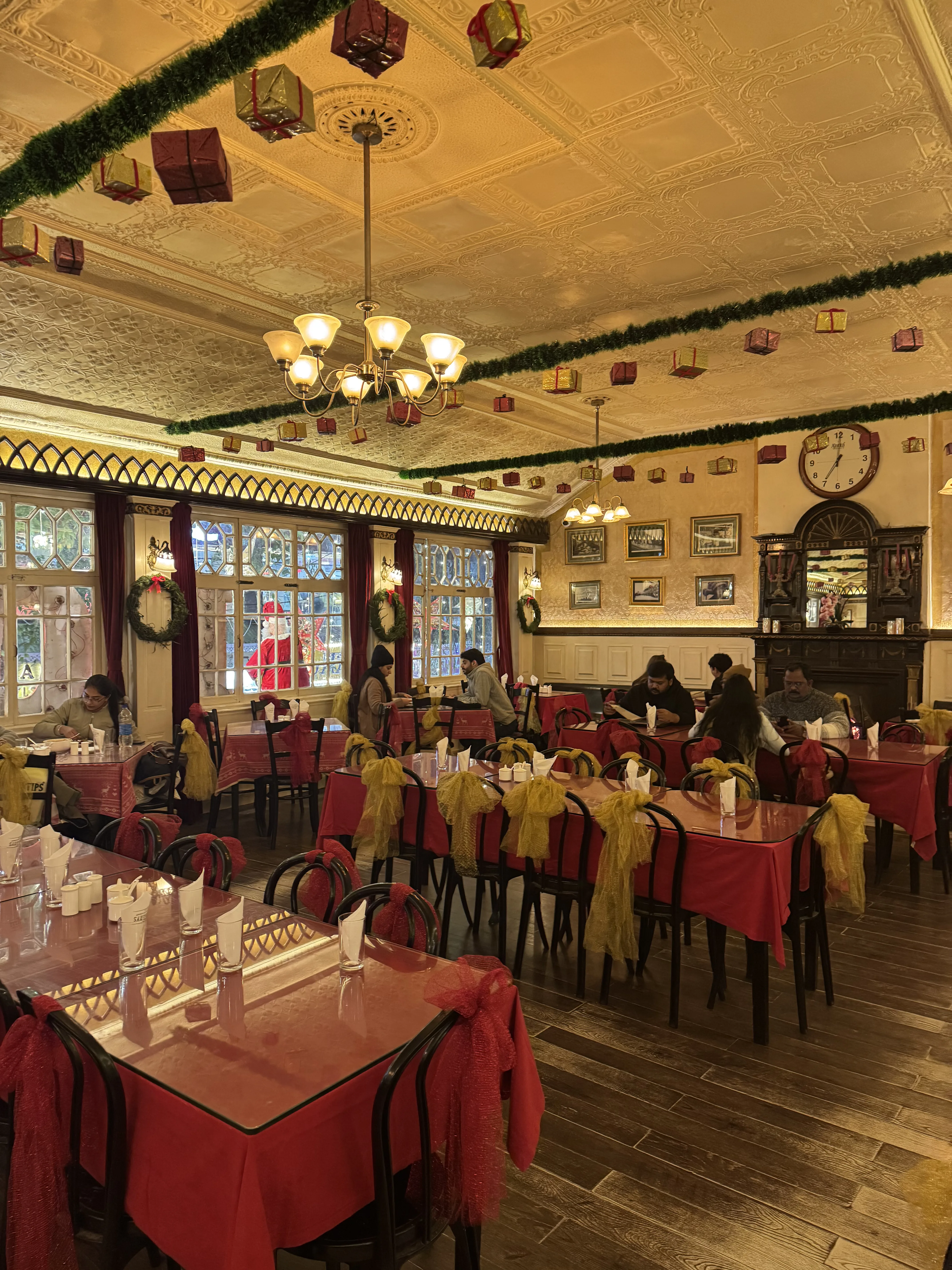
Inside Glenary’s — warm, nostalgic, and quietly bustling.
🌄 Evening in Darjeeling
As evening settled in, Darjeeling softened. The hills slipped into silhouette, and the sky warmed briefly before giving way to night.
Sunset over Darjeeling — the town exhaling into night.
🏺 Nepal Curio House
Cultural Note
Shops like Nepal Curio House are often associated with the literary world of Satyajit Ray’s Feluda — spaces where mystery, artifacts, and cultural overlap quietly coexist.
A stop at Nepal Curio House felt oddly familiar.
For anyone who has grown up reading Satyajit Ray’s Feluda stories, this place feels like it has stepped straight out of those pages — cluttered shelves, curious objects, and the faint sense that every artifact might have a story of its own. While not a direct setting from Ray’s work, shops like these are frequently evoked in his Darjeeling narratives, especially in Darjeeling Jomjomat.
The store itself was a dense, fascinating collection of handicrafts and artifacts — Tibetan masks, Nepali souvenirs, and odds and ends that felt deliberately out of place. It wasn’t hard to imagine Feluda pausing here, observing quietly, connecting invisible dots.
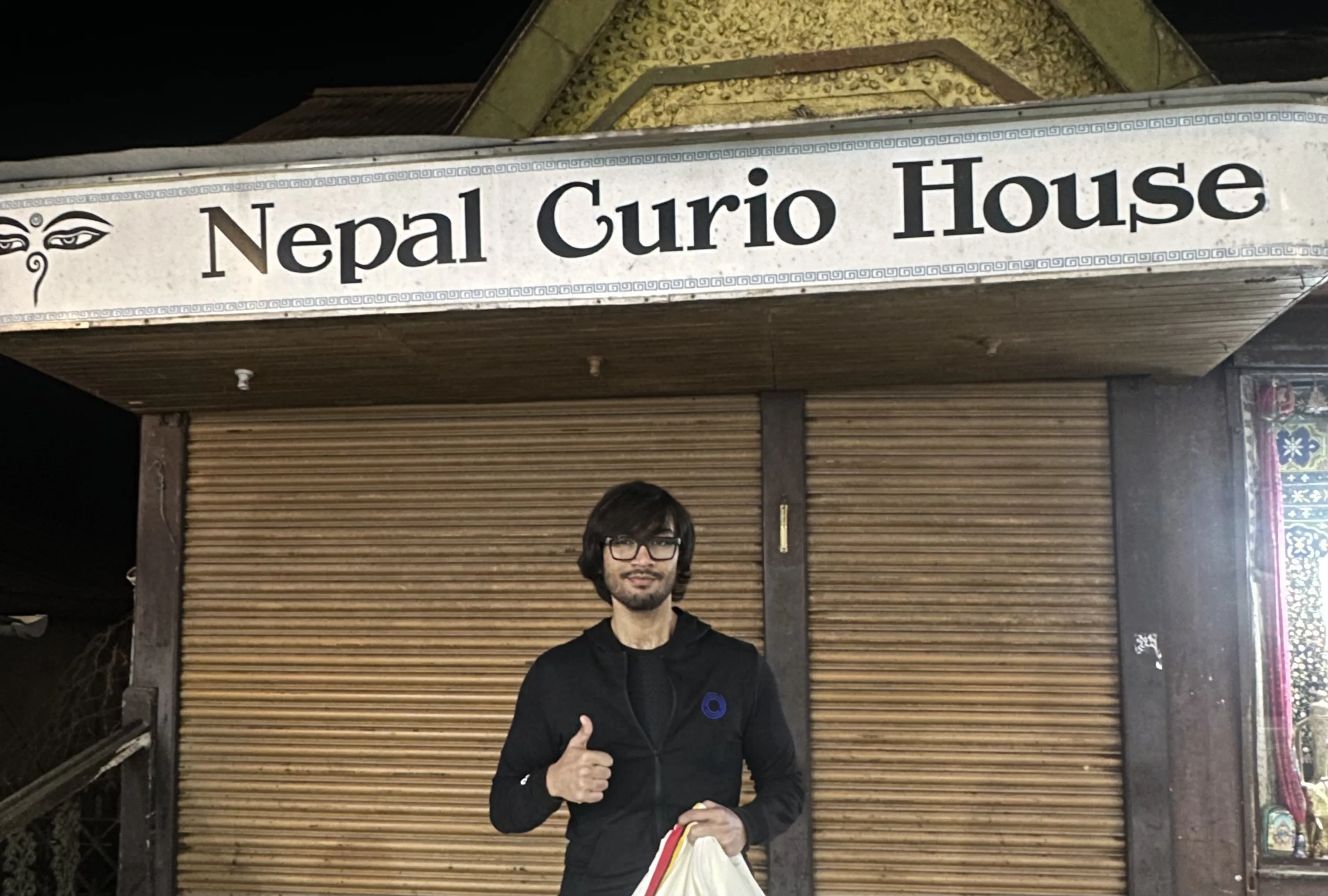
Nepal Curio House — where every object feels like a potential clue.
🌌 Observatory Hill — Under the Night Sky
Historical Note
Observatory Hill has long been a site of spiritual and cultural importance, home to temples and vantage points that offer panoramic views of both the town and the sky above.
Almost on impulse, I made a short run from Glenary’s to Observatory Hill.
Under a vast, cloudless sky, I witnessed something quietly extraordinary — a billion stars scattered overhead, like grains of salt across a deep blue-black canvas of space. Standing there, the universe felt impossibly large, and I felt perfectly small.
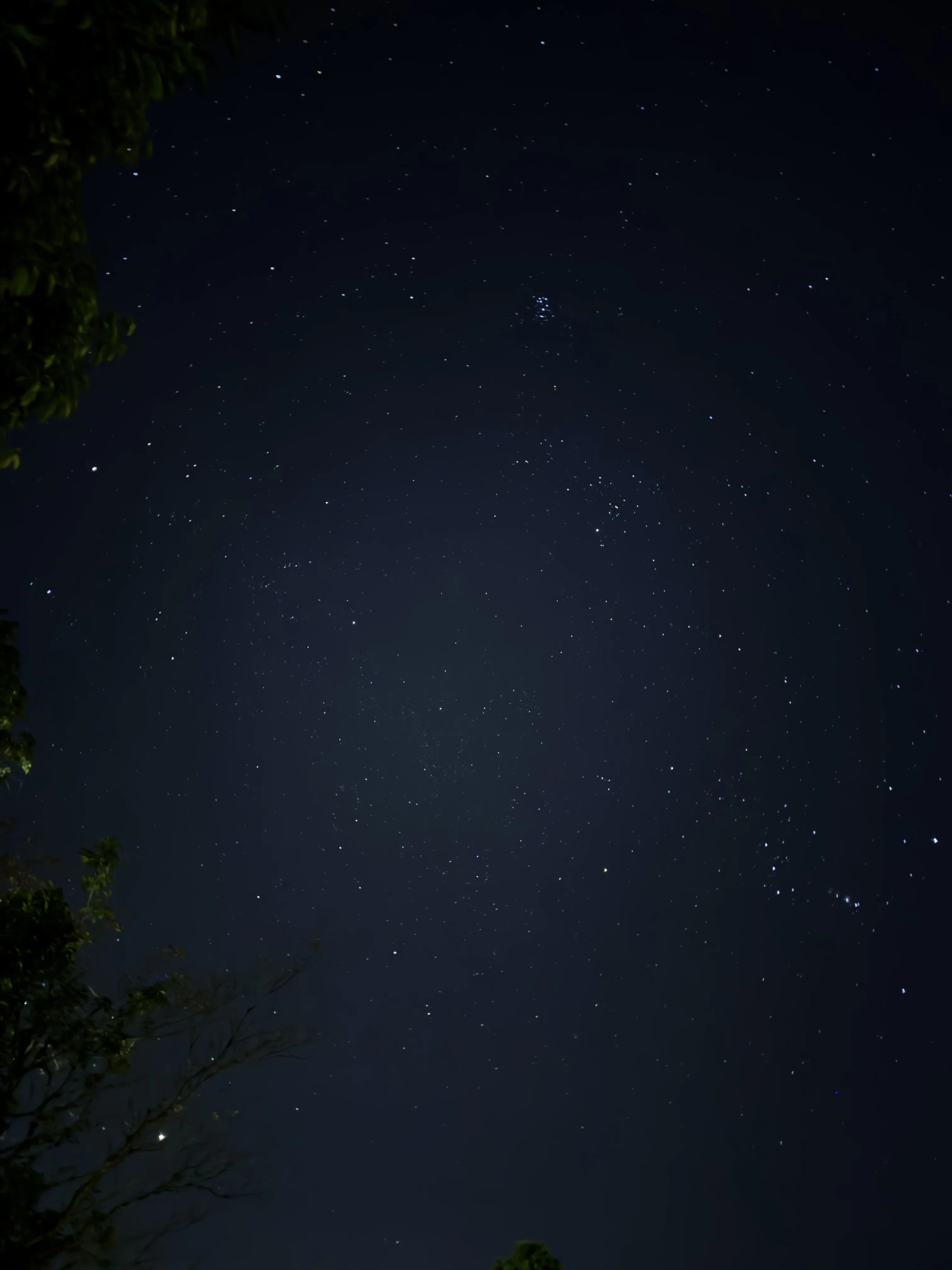
A billion stars above Observatory Hill — perspective, restored.
🌄 Day 2 — Darjeeling Exploration
After the long previous day, I made a conscious decision not to sleep in.
I wanted to meet the morning on its own terms — early, quiet, and unfiltered.
In fact, it was so early that it was still dark outside.
I laced up my shoes, layered myself into three levels of insulation (paired somewhat optimistically with running shorts), and stepped out into the cold. The plan was simple: a run to the Mall, and then onward to Observatory Hill — just in time for sunrise.
By the time I reached the top, I was gasping for breath — partly from the climb, partly from the thin mountain air at roughly 2,100 meters above sea level. But I had made it.
Just in time.
Sunrise over Kanchenjunga — the day beginning in silence.
I stood there longer than I expected to.
The moment invited reflection — on the year gone by, on life, on goals both achieved and quietly abandoned. It was a reminder of the sheer scale of our planet, something easy to forget when most days are spent behind desks and glowing monitors.
I found myself slipping into a flow state — present, drifting, and oddly grounded all at once.
Here, there, and everywhere.
There was a quiet echo in my head — a scene I’ve returned to often, one worth revisiting again. (Must watch again.)
🌍 Perspective
Reflection
Carl Sagan once described Earth as a “pale blue dot” — a fragile speck suspended in a sunbeam, orbiting an unremarkable star in a vast, ordinary galaxy.
Standing there, that idea felt tangible.
In the grand scheme of the universe, everything about our existence is ordinary.
And yet, in that moment, it felt profoundly special.
It was remarkable.
It was us.
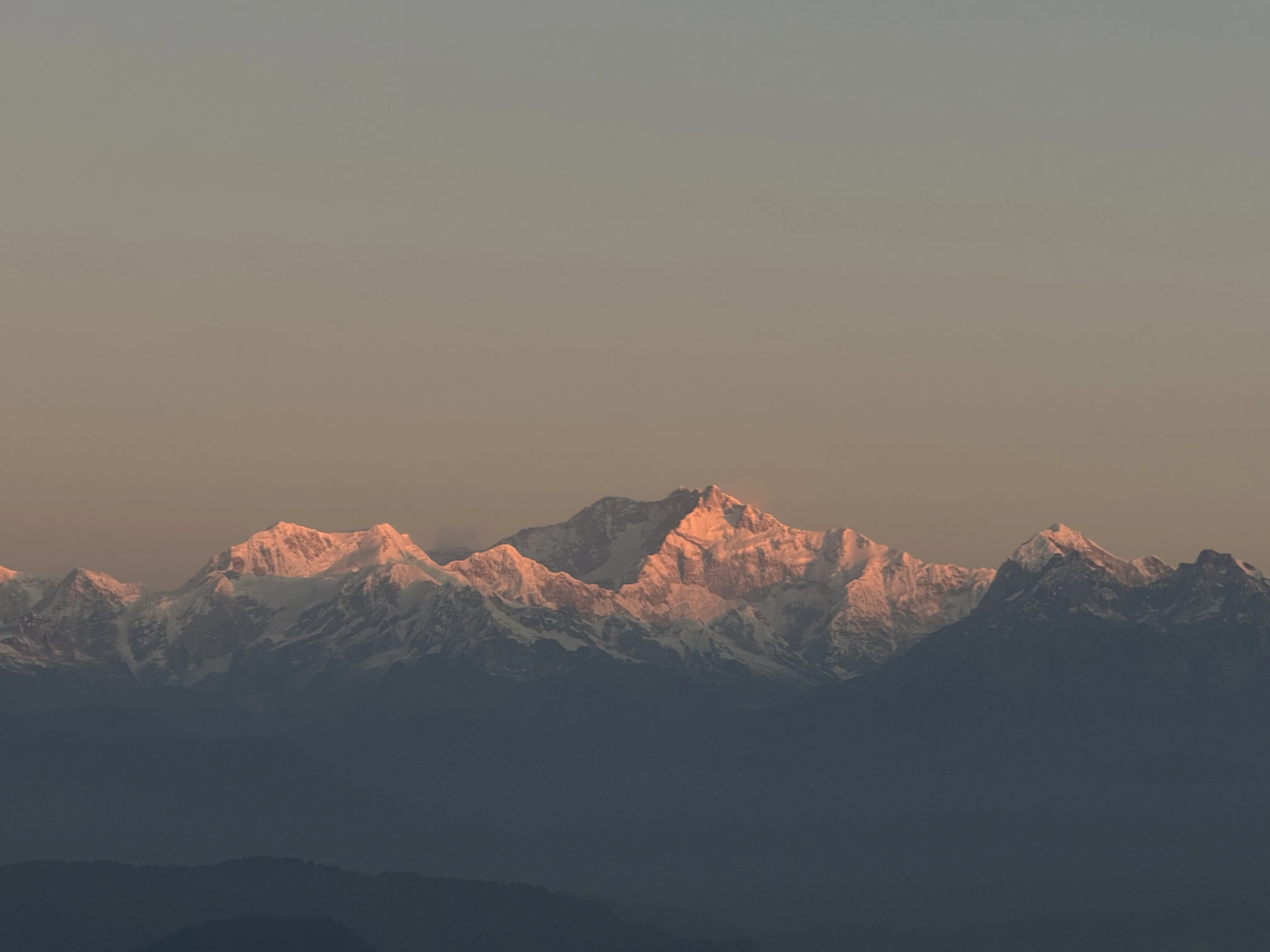
Kanchenjunga at sunrise — light, scale, and perspective.
Alright — enough of the altruistic talk about life and philosophy.
I ran over to a nearby open-air multi-gym and worked out in the blistering cold, slowly chipping away at my long-standing aversion to low temperatures. It wasn’t graceful, but it felt like a small personal victory.
From there, I ran straight back to the hotel — just in time for the all-inclusive breakfast.
Obviously, that wasn’t something I was about to miss.
🛍️ Morning Wanders
The rest of the morning unfolded at a gentler pace. We spent some time shopping for family and friends — the familiar ritual of souvenirs and small tokens that feel oddly important while traveling.
Soon enough, the question that defines most trips surfaced:
What do we eat for lunch?
I had already compromised that decision with an ice cream cone from Keventers — a place that feels lifted straight out of a Feluda story, where everyday settings quietly become part of the narrative. A quick, entirely predictable lunch at Glenary’s followed (no regrets).
The afternoon tapered off into preparation mode, as we readied ourselves for the excursion planned for the next day.
Historical Note
Keventers traces its origins back to the early 20th century, when it began as a dairy enterprise in the eastern Himalayas. Over the decades, it has become synonymous with Darjeeling’s street-side indulgences — milkshakes, ice creams, and a quiet sense of nostalgia tied to generations of visitors.
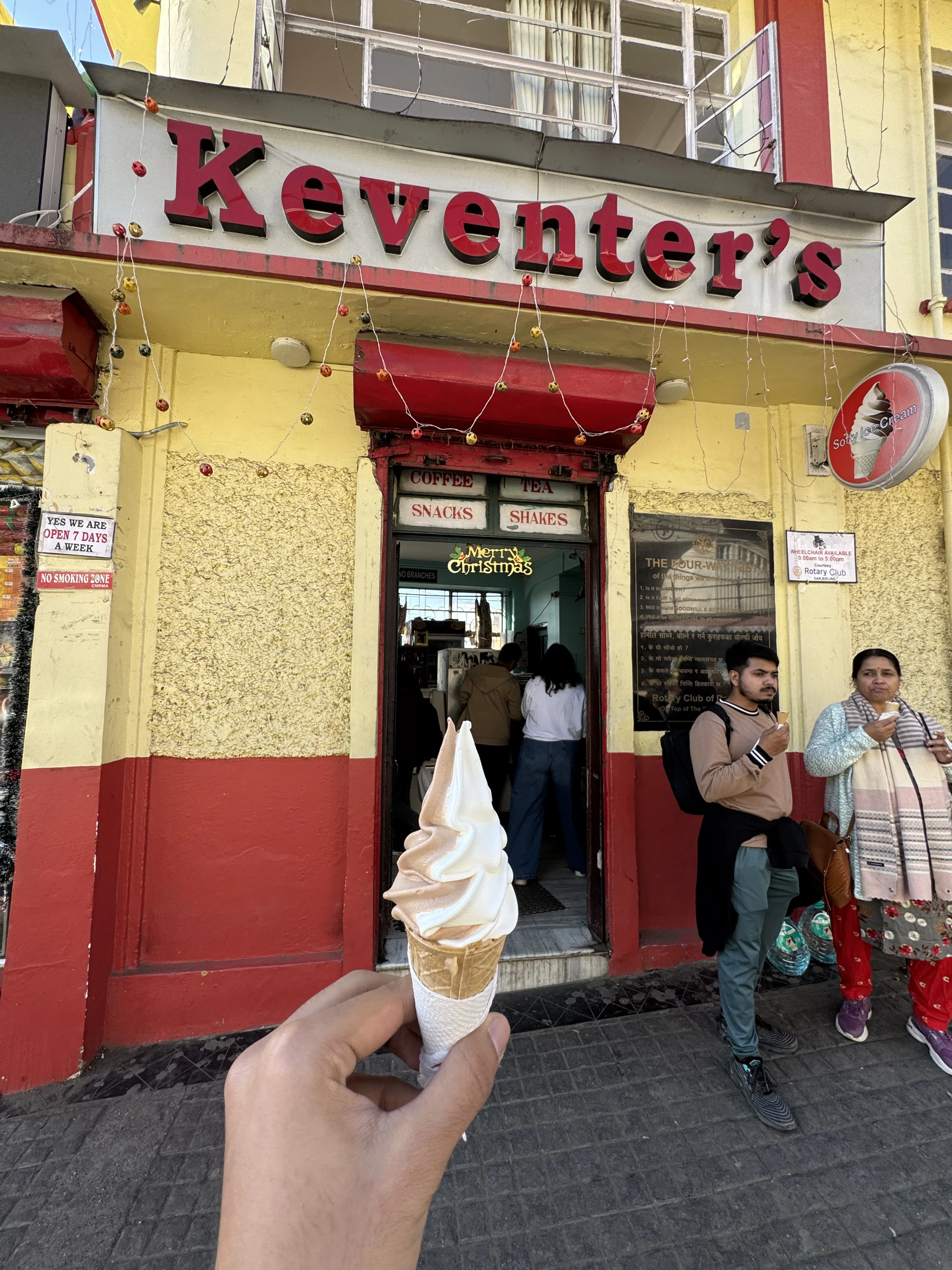
An ice cream cone from Keventers — poor timing, excellent decision.
🚗 Day 3 — Sightseeing & More
To cut the suspense, we had booked a cab for the day — one that would take us through most of Darjeeling’s well-known landmarks.
We woke up early (a pattern by now), had breakfast, and set out for the first stop of the day: Batasia Loop.
🌄 Batasia Loop
Historical Note
Batasia Loop is a remarkable engineering feat of the Darjeeling Himalayan Railway, designed to help the toy train navigate a steep gradient through a spiral loop. At its center stands a war memorial dedicated to Gorkha soldiers who lost their lives in various conflicts after India’s independence.
Part tourist attraction, part place of quiet remembrance, Batasia Loop manages to hold both roles gracefully. From here, the views open up dramatically — rolling hills, the toy train tracks curving with intent, and on clear days, Kanchenjunga standing watch in the distance.
The memorial at the center grounds the place, reminding visitors that this scenic beauty is also layered with history and sacrifice.
The sweeping curve of Batasia Loop — engineering and landscape in quiet harmony.
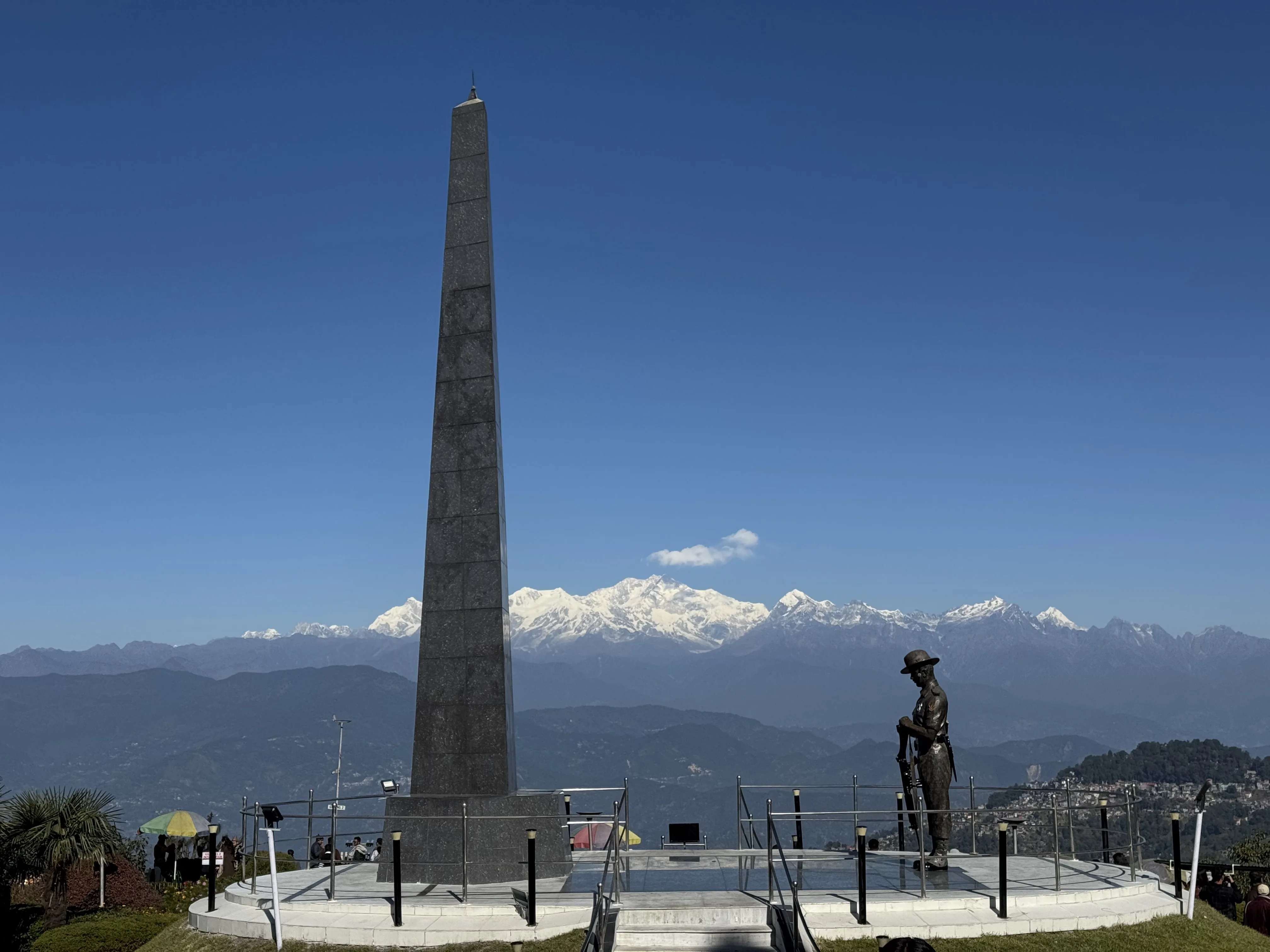
The Gorkha War Memorial — a place of reflection amid the hills.
🚡 Darjeeling Ropeway
Historical Note
Officially known as the Darjeeling Passenger Ropeway, this cable car system was established in the late 1960s to connect the hill town with the tea gardens below. Originally intended to aid tea estate workers and transport goods, it has since become one of Darjeeling’s most popular tourist attractions.
Our next stop was the Darjeeling Ropeway — easily one of the most talked-about experiences in town.
From a distance, it looked calm enough. Up close, it was clear why patience was required.
After waiting in line for one hour and nine minutes (yes, we counted), it was finally our turn. As the cabin lifted off, the views opened up beautifully — tea gardens unfolding below, the town slowly shrinking behind us, and Kanchenjunga standing tall in the background.
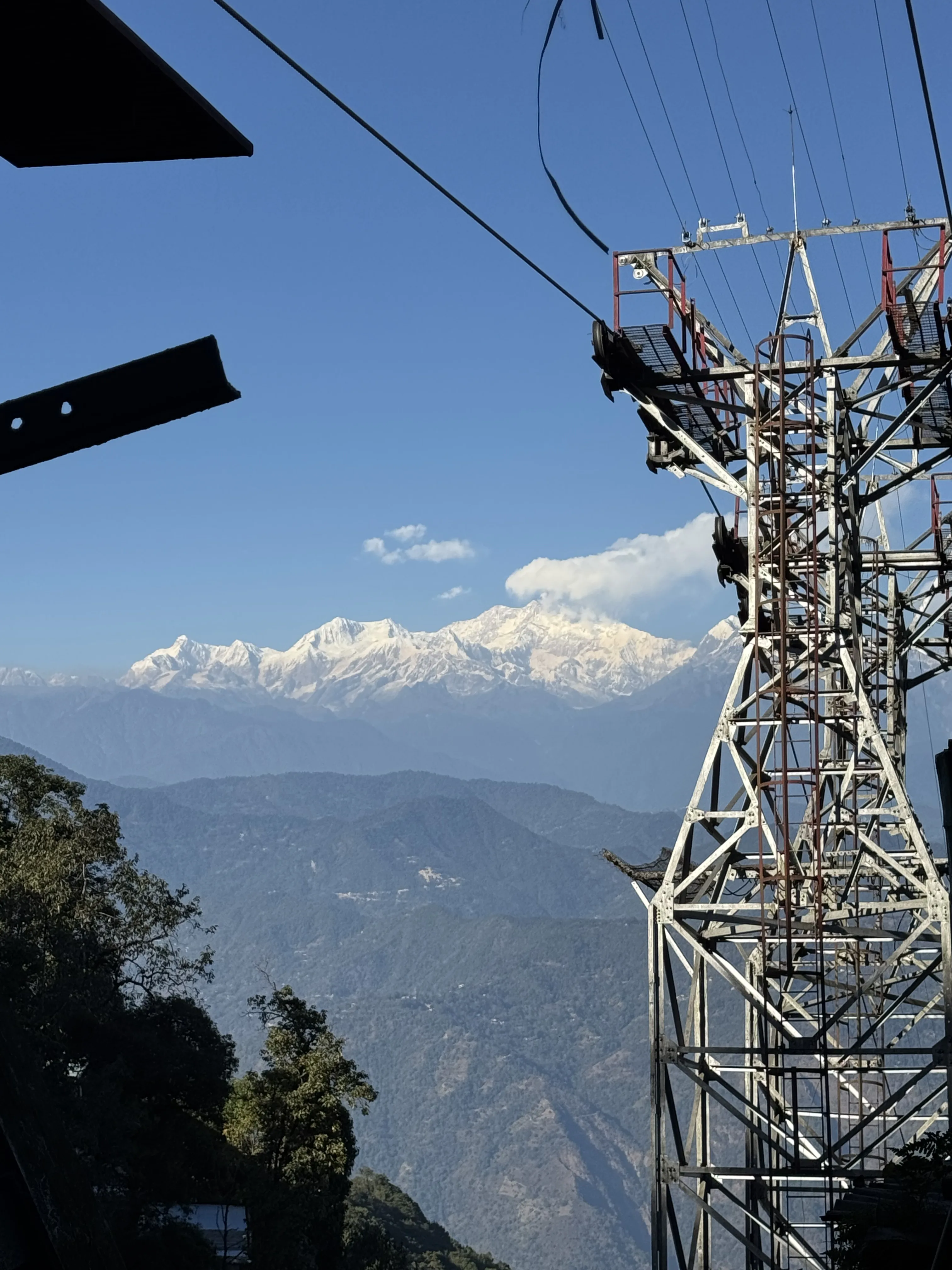
The ropeway cutting across the hills — Kanchenjunga keeping watch.
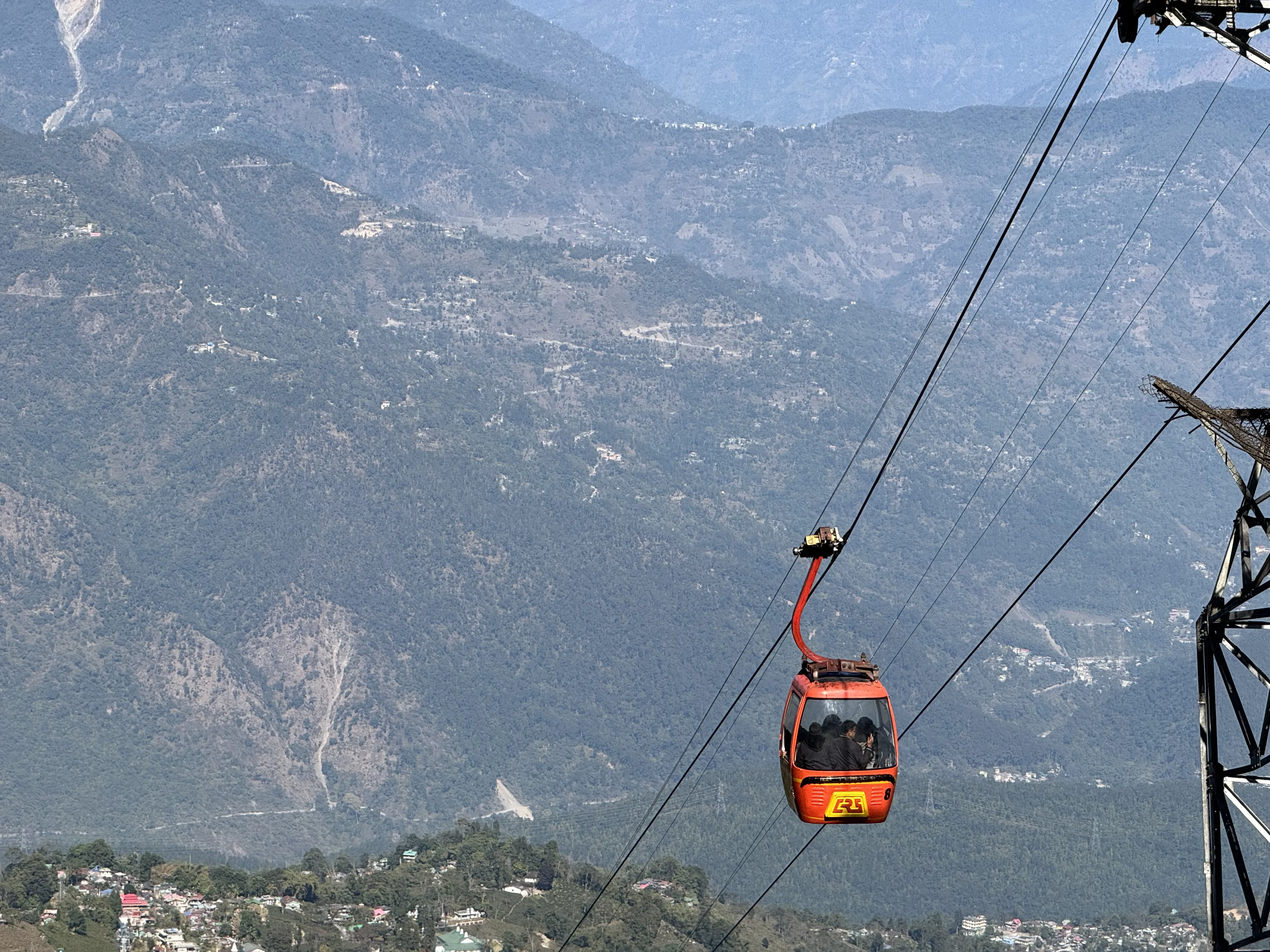
Inside the cabin — suspended views and quiet anticipation.
We were off to a smooth start, but midway through the descent, the ropeway came to an unexpected halt — lingering there for about ten minutes. Given my well-documented fear of heights, those ten minutes felt significantly longer than advertised.
Thankfully, the ride resumed soon after. We continued down to the turning point and began the ascent back up, the initial tension slowly giving way to awe once again.
On the way up, I managed to capture what might be my favorite clip of the day — a time-lapse that somehow made the wait worth it.
Time-lapse from the ropeway — tea gardens drifting past beneath us.
🧗 Tenzing Rock
Historical Note
Tenzing Rock is named after Tenzing Norgay, the legendary Sherpa mountaineer who, along with Sir Edmund Hillary, was among the first to summit Mount Everest in 1953. The rock serves as both a tribute and a popular training ground for aspiring climbers.
Our final stop for the day was Tenzing Rock.
Watching climbers make their way up was impressive in its own right, but with a queue stretching well over two hours, combined with an early breakfast and steadily declining energy levels, we decided to admire it from the ground instead.
Some victories are knowing when not to climb.
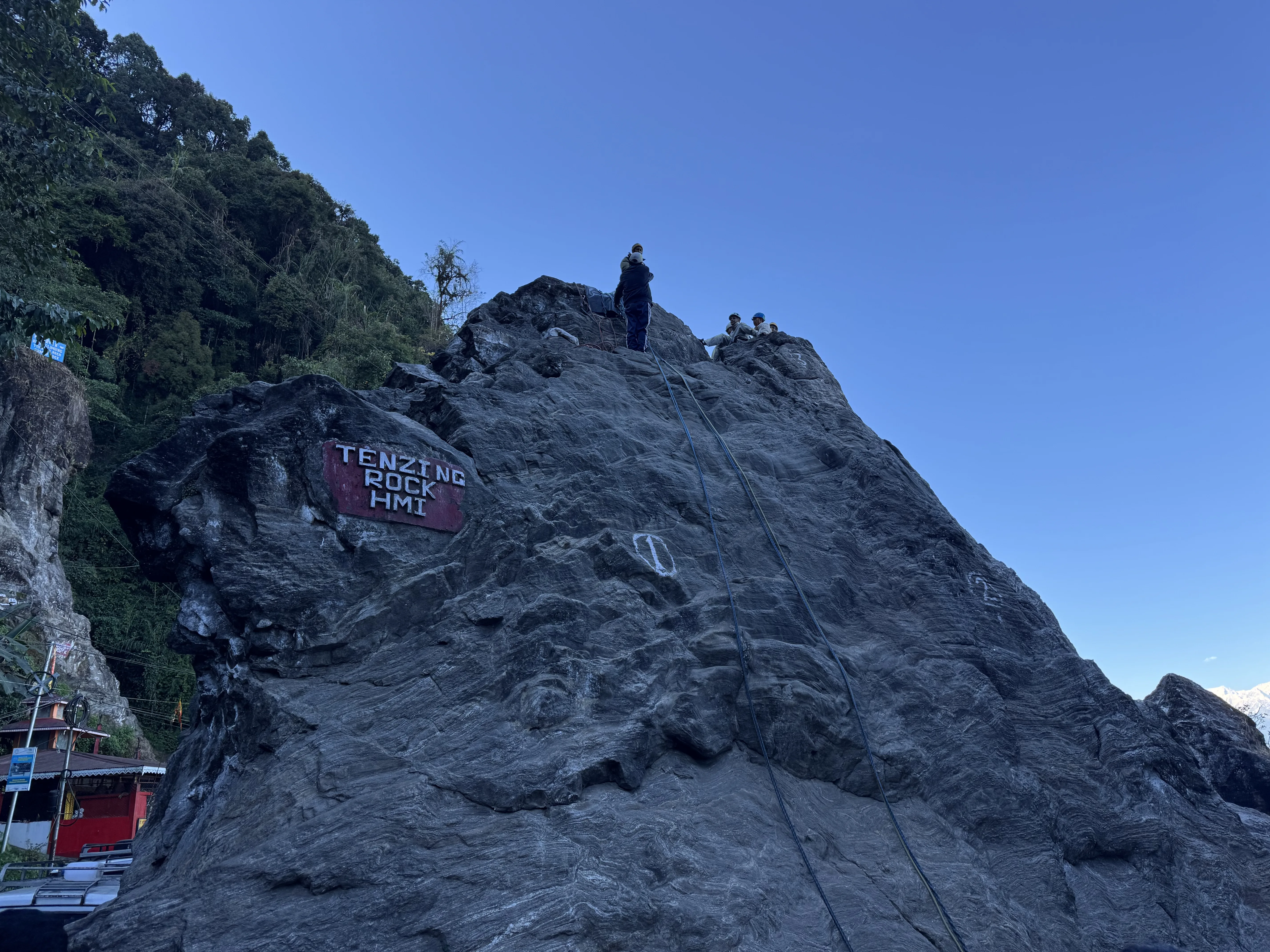
Tenzing Rock — a tribute to mountaineering grit and quiet determination.
🍽️ One Last Meal (You’ll Never Guess Where)
Lunch followed soon after — our final one in Darjeeling — and yes, it was back at Glenary’s.
At this point, consistency felt less like a lack of imagination and more like loyalty.
From there, we made a final stop to pick up Darjeeling first flush tea for family and friends.
Cultural Note
In tea production, a flush refers to the period when tea leaves are harvested. First flush tea is picked in early spring and is prized for its light color, floral aroma, and delicate flavor — often considered the most sought-after Darjeeling tea of the year.
With bags packed slightly heavier and hearts a little fuller, it slowly sank in that this was our last day in Darjeeling.
We had come here looking for mountains, stories, and a brief pause from routine — and somehow, we found all three.
Closing Thoughts
Darjeeling gave me many things — misty mornings, winding roads, familiar cafés, and a first, unforgettable glimpse of Kanchenjunga. But more than any landmark or itinerary, it offered something quieter.
Perspective.
Between early-morning runs in the cold, long waits at ropeways, and unplanned pauses at tea gardens and cafés, time began to behave differently. Days slowed. Moments stretched. The usual urgency of routine softened into something more observant.
Perhaps that’s why Darjeeling has lived so vividly in stories — from Satyajit Ray’s Feluda to the countless travelogues that came before this one. It’s a place that invites attention, rewards patience, and leaves just enough unsaid for the imagination to fill in.
As the hills faded into memory and the journey wound its way back home, I carried with me more than photographs and souvenirs. I carried a renewed appreciation for stillness, for scale, and for how small shifts in setting can quietly realign how we see ourselves.
Some places stay with you because they are extraordinary.
Others because they remind you how to notice.
Darjeeling managed to do both.
On one of our last walks, outside Glenary’s, I noticed a simple word lit up above the entrance — Hope.
It wasn’t dramatic or profound in the moment. Just a word, glowing quietly against the evening. But after days of mountains, stories, early mornings, and unhurried pauses, it felt like the right note to end on.
Not a conclusion — just a reminder that journeys don’t really end where photographs stop.
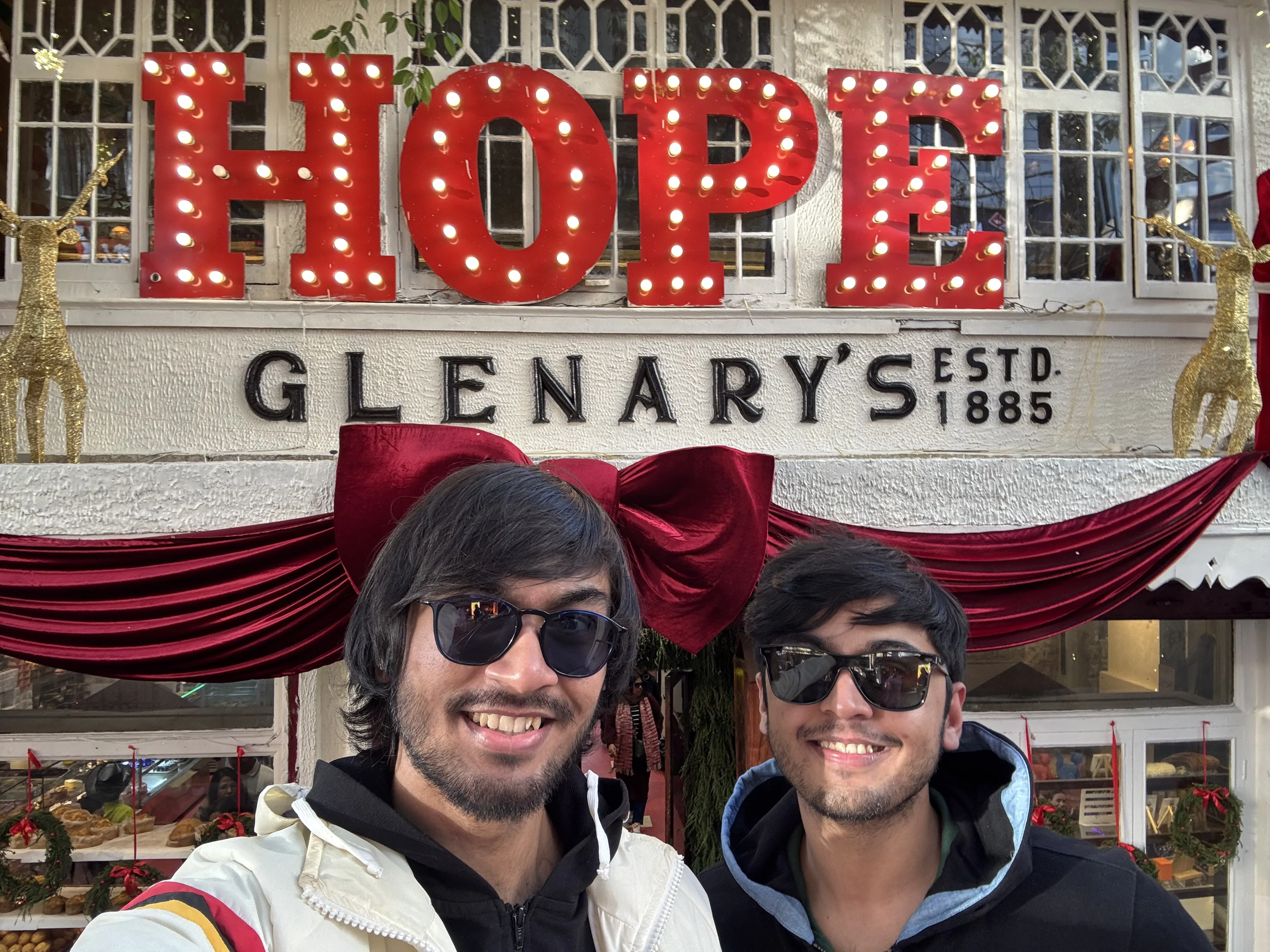
Hope — outside Glenary’s, where the journey quietly came full circle.